


It is a wonderful, yet often toxic, digital landscape that we inhabit.
While negativity can spread quickly online, Malaysians say the digital space also offers a chance to inspire, connect and build understanding.
Microinfluencer Layka Naidi has dealt with online harassment firsthand.
Whether it’s facing criticism for her food reviews or backlash from unsatisfied followers, she initially found the negativity overwhelming.
“At first, it was disturbing and I considered stopping my content creation,” she said, referring to the time when she took a break from it for almost a year.
Over time, she has learnt to navigate these challenges, often sharing her frustrations with friends or responding to hateful comments with courtesy.
However, Layka has observed a shift in how the public thinks.
“People are increasingly raising awareness about bullying and online hate,” she said, noting that more people are now willing to intervene and address excessively harsh comments.
Law student Ho Jia Wen, 26, said most of the social media content she engages with is positive.
“I generally follow accounts about a multicultural Malaysia. These posts are about unity through food and our shared mannerisms and slang.
“It makes me appreciate our melting pot of different cultures,” she said.
Despite this, she has encountered racist remarks online.
“It is disturbing that some people can still hold such opinions,” said Ho, who tries to interact positively by supporting multicultural content and avoiding divisive issues.
Allied Coordinating Council of Islamic NGOs (ACCIN) chief executive officer Mohd Jamaludin Shamsudin described social media as both powerful and dangerous.
“One of the most common forms of negativity I’ve encountered is personal attacks or character shaming, especially in the comment sections where anonymity empowers people.
“They include racial slurs, misogynistic remarks, cyberbullying and aggressive cancel culture. I’ve also seen misinformation weaponised to attack others, leading to real-world consequences,” he said.
At the same time, he said social media has also shown “incredible empathy and support”, with strangers rallying to raise funds, provide comfort and amplify causes.
“Constructive conversations, where people respectfully disagree and learn from one another, are some of the most rewarding interactions,” he said.
Mohd Jamaludin added that ACCIN moderates comments, enforces guidelines and responds with clarity and kindness.
“We also encourage more Malaysians to think before they type.
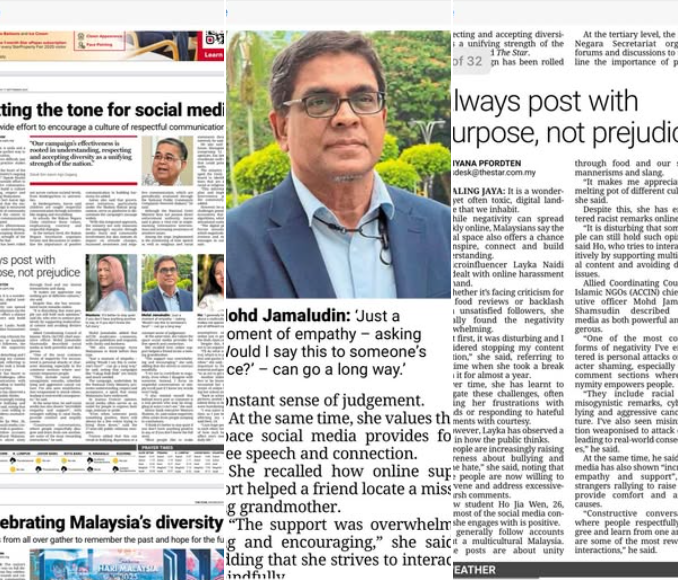
“Just a moment of empathy – asking ‘Would I say this to someone’s face?’ – can go a long way,” he said, noting that campaigns like “Cakap Baik-Baik” are timely and much needed.
The campaign, undertaken by the National Unity Ministry, promotes understanding, respect and acceptance, a spirit that many Malaysians have embraced.
In Joanna Francis’ opinion, social media often serves as an outlet for people to express their rage, jealousy or pride.
“Even when someone posts something positive, there will always be a few voices trying to bring them down,” said the 27-year-old public relations executive.
Francis added that this can result in bullying, depression or a constant sense of judgement.
At the same time, she values the space social media provides for free speech and connection.
She recalled how online support helped a friend locate a missing grandmother.
“The support was overwhelming and encouraging,” she said, adding that she strives to interact mindfully.
“I try not to contribute to negativity, even when I disagree with someone. Instead, I focus on respectful conversations or simply scroll past if I know my words won’t help.
“I also remind myself that behind every post or comment is a real person who may be struggling in ways I can’t see,” she said.
Senior bank executive Mastura Shahrin, 41, said online negativity often arises from people jumping to conclusions.
“I think it’s better to stay quiet if you don’t have anything positive to say, or if you don’t know the full story.
“Most people like to make assumptions and spread lies online just to get attention,” said the Shah Alam resident.
Despite this, Mastura chooses not to let negativity affect her.
“I’ll do what is within my control, which is to post positive content and quotes to spread positive vibes,” she said, adding that it is important to focus on uplifting material and ignore toxic remarks “so as not to get engulfed”.
Another individual, who prefers to be known only as Devi, recounted her experience as a victim of online harassment during her school years.
“Back in school, a girl took my pictures, posted them online and edited them to the point that they were humiliating to me.
“I was naive and scared at the time, so I just let it go despite it affecting my self-confidence,” said Devi, 24.
“I just hope people will be nicer to each other; we have seen news of how such harassment could affect one’s mental health and daily life.”